

Producing poultry feed on the farm or at a commercial feed facility can offer greater control over ingredients, formulation, and production schedules. However, equipment investment should be evaluated carefully before purchasing. The cost of a feed processing system depends on much more than the pelletizing machine itself. Capacity, raw materials, automation, supporting equipment, and plant configuration can all influence the final investment.
For buyers researching chicken feed pellet machine, understanding these factors first can make equipment comparisons much more meaningful.
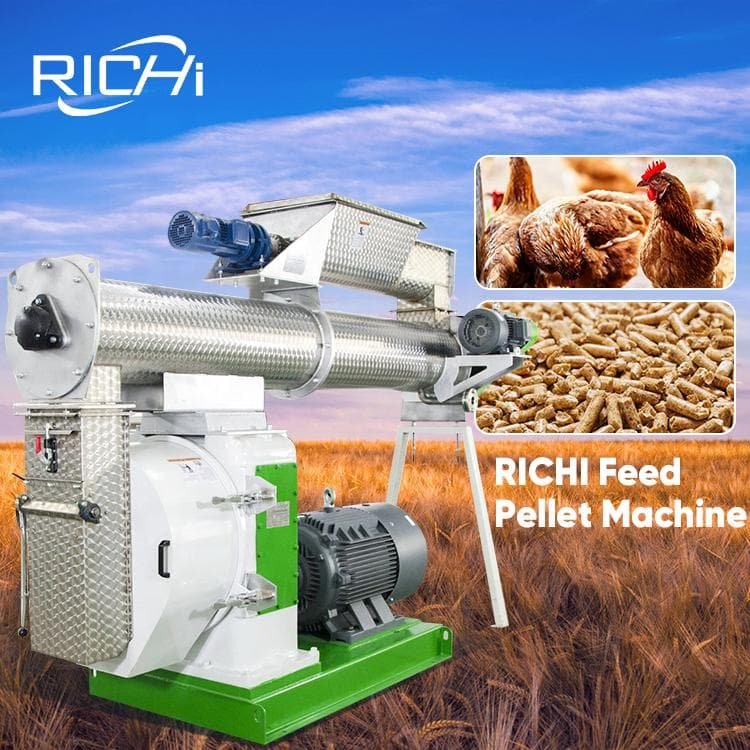
Capacity Is the Starting Point
Production capacity is one of the most important factors affecting equipment selection. A small poultry farm may only require several hundred kilograms of feed per hour, while a commercial operation may need several tons per hour.
The required capacity should be calculated from actual daily feed consumption and planned operating hours. For example, a farm that consumes several tons of feed each day may not need an industrial-scale system if it can operate the equipment for several hours.
It is also useful to leave some room for future growth, particularly when the poultry population is expected to increase.
What Ingredients Will Be Used?
Poultry feed can contain corn, soybean meal, wheat, wheat bran, rice bran, fish meal, vitamins, minerals, and other ingredients.
Each material has different physical characteristics. Corn and other grains may require grinding before mixing, while fibrous ingredients can require additional preparation.
Particle size can influence mixing uniformity and pellet quality. Therefore, the grinding section should be selected according to the actual formulation rather than using a standard configuration for every project.
Moisture is another consideration. Proper moisture management can help improve pellet formation and reduce problems during production.
Why Is a Mixer Important?
Before pelletizing, ingredients must be combined according to the feed formula. A well-designed mixing process helps distribute protein sources, grains, minerals, and other components evenly throughout the batch.
For commercial poultry operations, batching accuracy becomes increasingly important as production volume increases.
The mixer should also be coordinated with the pelletizing capacity. If the mixer is too small, it can become a bottleneck even when the pellet machine has sufficient theoretical output.
Looking at Other Livestock Feed Equipment
Farmers who raise multiple species may want their feed-processing system to handle more than one formulation.
For example, rabbit pellet making machine price can be relevant when a producer is comparing equipment for another livestock feeding application. Rabbit and poultry feed are different products, but both require controlled ingredient preparation, mixing, and pelletizing.
The comparison is useful because it demonstrates why equipment should be evaluated according to formulation, pellet diameter, raw material characteristics, and output instead of focusing only on the machine’s name.
Grinding and Material Preparation
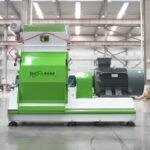
A hammer mill is commonly used to reduce the particle size of grain and other suitable feed ingredients.
Proper grinding can improve mixing performance and help create more consistent pellets. However, excessively fine grinding is not always necessary. The ideal particle size depends on the formulation, animal requirements, and pelletizing process.
For farms using large amounts of corn or other grains, the grinding system should have sufficient capacity to continuously supply the mixer.
Pelletizing and Pellet Quality
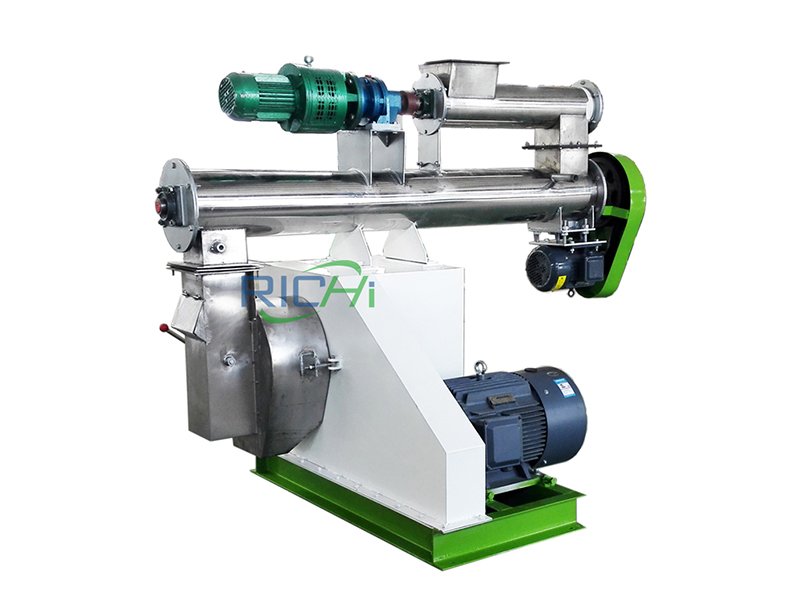
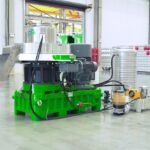
During pelletizing, prepared feed is compressed through die holes to form cylindrical pellets. The die specification determines the approximate pellet diameter.
Different poultry production systems may require different pellet sizes depending on bird age and feeding strategy.
Pellet quality is influenced by several variables, including formulation, moisture, particle size, conditioning, and machine operating conditions. A higher-capacity machine does not automatically produce better pellets if the upstream preparation process is poorly controlled.
Cooling, Screening, and Storage
Fresh pellets normally require cooling before long-term storage. A cooler helps reduce pellet temperature and stabilize the product after pelletizing.
Screening can then remove excessive fines and irregular particles. Depending on the plant configuration, fines may be recycled into the production process.
Storage should protect finished feed from moisture and contamination. Larger plants may use storage bins and automated conveying systems to reduce manual handling.
Automation and Overall Investment
Automation can significantly change the structure of a feed project. A basic system may rely on manual ingredient handling and simple controls, while a commercial plant may use automatic batching, centralized control, conveyors, weighing systems, and packaging equipment.
Therefore, buyers should compare complete system configurations rather than comparing equipment prices in isolation.
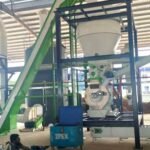
A properly configured pellet production line can connect raw material preparation, grinding, mixing, pelletizing, cooling, screening, and packaging into one continuous workflow.
Before purchasing, it is helpful to prepare information about raw materials, feed formulas, daily demand, target pellet size, operating hours, available space, and expected future capacity. Buyers can also review check this site out when gathering additional information for feed-processing equipment research.
The most economical system is not necessarily the machine with the lowest initial quotation. A better investment is one that matches production requirements, operates efficiently, and can continue supporting the poultry operation as its feed demand develops.
Related post:https://pelletizerequipment.com/poultry-feed-pellet-machine/