


Pellet plant buyers often spend most of their evaluation time on machines: pellet mill power, die size, grinder capacity, cooler model, gearbox brand, and steel thickness. Those details matter, but a complete plant succeeds or fails as a system. Engineering capability determines whether the individual machines are selected correctly, arranged logically, connected safely, supplied with the right utilities, controlled in the correct sequence, and accessible for operation and maintenance. A manufacturer can build strong machines and still deliver a weak project if the engineering around those machines is incomplete.
A Pellet Plant Is A System, Not A Collection Of Machines
A complete pellet plant includes material receiving, cleaning, size reduction, storage, dosing, conditioning, pelleting, cooling, screening, conveying, dust collection, packaging, utilities, electrical control, steel structures, and civil interfaces. Each section affects the sections before and after it. If the grinder produces an unsuitable particle-size distribution, the pellet mill may consume more energy. If the cooler is undersized, product temperature and moisture may remain too high. If conveyors are not coordinated, a downstream trip can cause upstream blockage.
Engineering capability is what connects these interactions. It converts the customer’s raw material and production goal into one operating process instead of a list of catalog machines.
Machine Manufacturing Answers “Can We Build It?”
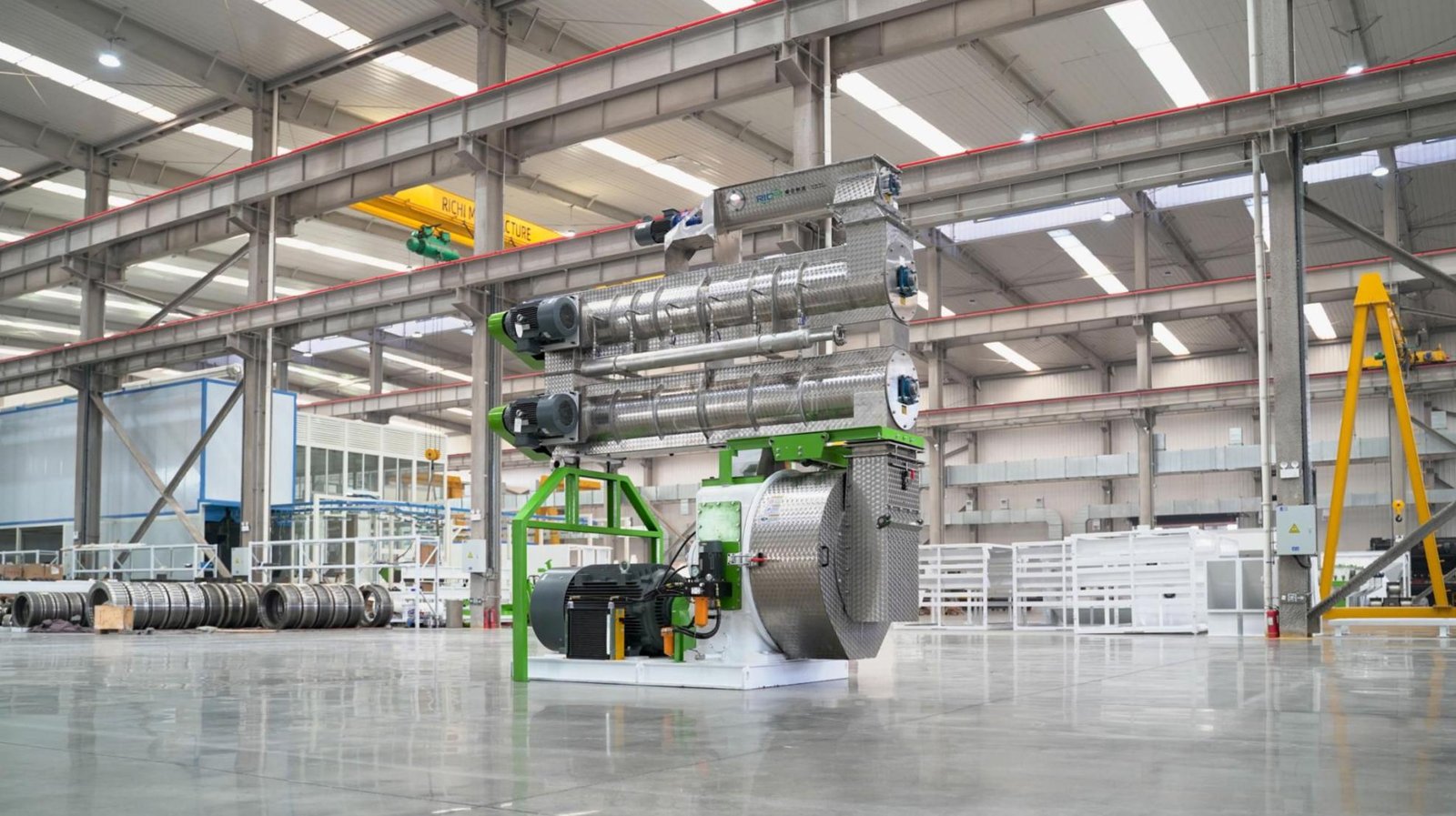
Manufacturing capability concerns physical production. It includes machining shafts and housings, fabricating frames and bins, welding structures, assembling bearings and gearboxes, wiring electrical panels, inspecting dimensions, testing machines, painting, packing, and shipping. Buyers should absolutely verify these capabilities because manufacturing quality affects reliability and service life.
However, manufacturing alone does not answer whether the machine is appropriate for a particular project. A perfectly manufactured pellet mill can still be the wrong choice if raw-material properties, expected throughput, pellet diameter, operating hours, or upstream preparation were misunderstood.
Engineering Answers “Should We Build It This Way?”
Engineering starts before fabrication. It defines design assumptions, process flow, equipment sizes, buffer capacity, building arrangement, utility requirements, structural loads, automation philosophy, safety interfaces, and maintenance access. This work determines whether the equipment being manufactured will function correctly when connected at the customer site.
- What raw material will be processed, and how variable is it?
- What moisture and particle size enter the pellet mill?
- What pellet size and quality are required?
- How many hours per day and days per year will the plant operate?
- What power, steam, fuel, water, and compressed air are available?
- What are the building height and footprint limits?
- How will operators clean, inspect, and maintain the equipment?
- What expansion is expected in the future?
Without answers to these questions, machine selection is based on assumptions that may be invisible to the buyer.
Engineering Protects Capacity Claims
Nominal machine capacity is not the same as plant capacity. Throughput depends on raw material, moisture, formulation, particle size, die specification, conditioning, motor loading, cooler performance, screen losses, and operating stability. Engineering defines the boundary conditions under which a stated capacity is realistic.
For biomass pellets, this is particularly important because raw materials can vary widely in density, moisture, fiber structure, ash content, and contamination. A line designed for dry sawdust may require major changes if the actual material is wet wood chips or agricultural residues. Engineering capability should identify those differences before equipment is ordered.
Good Engineering Reduces Hidden Bottlenecks
A pellet plant is only as productive as its limiting stage. If one conveyor, cyclone, cooler, screen, or packaging machine cannot keep up, the entire line is constrained. Professional engineering uses mass flow and operating assumptions to size each stage and provide reasonable buffer capacity.
Bottlenecks are often created not by the main pellet mill but by supporting equipment. Buyers should ask the supplier to identify the expected limiting stage under normal operation and explain how capacity changes when raw material or pellet specification changes.
Layout Engineering Affects Daily Operating Cost
Machine manufacturing cannot compensate for a poor layout. Excessive conveying distance increases motors, maintenance, transfer points, and dust generation. Insufficient maintenance space increases shutdown time. Poor access to filters or screens makes cleaning difficult. Unnecessary building height can increase steel and civil cost, while an overly compressed layout can make installation and service unsafe.
A professional layout balances footprint, gravity flow, maintenance access, operator movement, structural efficiency, fire and safety considerations, and future expansion. These are engineering decisions rather than machine-production decisions.
Electrical And Control Engineering Connects The Process
Every machine in a modern pellet plant must communicate with the rest of the system. Motors need protection, equipment needs permissives and interlocks, bins need level signals, drives need speed control, and alarms need to tell operators what caused a stoppage. A downstream trip should trigger a safe upstream response.
A strong equipment factory without capable electrical and automation engineers may deliver hardware that works individually but is difficult to operate as a line. Engineering should therefore include electrical load planning, control philosophy, PLC logic, HMI design, alarm structure, emergency stops, and commissioning procedures.
Engineering Is Essential For Site Interfaces
Pellet equipment is installed inside a real building with foundations, columns, utilities, access roads, containers, cranes, drainage, and local regulations. The engineering team must define which loads and interfaces belong to the equipment supplier and which belong to the local contractor. Foundation loads, anchor locations, openings, equipment elevations, and utility connection points should be documented early enough for site work.
Many expensive project delays occur because these interfaces were not defined before civil construction. A well-manufactured machine arriving at a site with the wrong opening size or insufficient crane access still creates a project problem.
Professional Engineering Makes Trade-Offs Visible
There is rarely one perfect pellet plant design. A lower-cost solution may use more manual handling. A compact layout may require greater height. More storage improves buffering but increases investment. More automation reduces operator intervention but increases instrumentation and commissioning complexity. Redundancy improves uptime but adds capital cost.
Professional engineers explain these trade-offs so the buyer can choose according to priorities. Weak engineering often hides trade-offs behind a single standard proposal and leaves the customer to discover the consequences after installation.
Manufacturing And Engineering Should Feed Back Into Each Other
The strongest suppliers connect engineering, manufacturing, commissioning, and service. Manufacturing teams identify parts that are difficult to fabricate. Site teams report maintenance-access problems. Commissioning engineers identify control or process issues. Those lessons should return to design drawings and future machines.
This feedback loop is a major reason to evaluate engineering capability alongside factory capability. If engineering and production operate as separate organizations with little communication, problems can repeat from project to project.
What Evidence Should A Buyer Request?
| Capability | Evidence | Why It Matters |
|---|---|---|
| Process engineering | Flow diagrams and design basis | Shows machine selection logic |
| Layout engineering | Detailed general arrangement | Shows access and integration |
| Structural engineering | Loads and steel drawings | Supports safe installation |
| Electrical engineering | Load lists and control drawings | Connects machines into a system |
| Manufacturing | Machining, fabrication, and inspection records | Shows physical production quality |
| Commissioning | Test and start-up procedures | Shows system verification |
How RICHI Machinery Fits This Evaluation
RICHI Machinery combines equipment manufacturing with complete pellet plant engineering. Buyers can review the company’s broader equipment and turnkey project scope through RICHI Machinery project service. The company has more than 30 years of industry experience and more than 2,000 delivered projects, which provides a large base of manufacturing and project feedback.
Those facts are useful only when translated into the current project. A buyer should still confirm which engineers will be assigned, what similar plants they have handled, what drawings will be delivered, and how manufacturing and commissioning teams coordinate with engineering.
Questions To Ask Before Choosing A Supplier
- What operating assumptions are used for the proposed capacity?
- Which process stage is expected to be the bottleneck?
- How does the design change if raw-material moisture changes?
- Who produces the layout and structural drawings?
- Who designs the electrical control philosophy?
- How is maintenance access checked?
- How are customer changes controlled?
- What documents are provided before civil construction?
- How does commissioning feedback reach the design department?
- Which parts of the project are engineered internally?
When Machine Manufacturing Can Matter More
If the buyer needs only a standard replacement machine that will be installed into an existing, well-defined process, manufacturing quality may dominate the decision. In that case, interfaces, layout, and utilities are already known. Even then, the supplier still needs enough engineering capability to confirm compatibility, motor requirements, dimensions, and control signals.
For a new complete plant, however, engineering and manufacturing are inseparable. The earlier the project stage and the more customized the raw materials or site, the more important engineering becomes.
Final Recommendation
Engineering capability should matter as much as machine manufacturing capability because a pellet plant is an integrated production system. Manufacturing determines whether the physical equipment is built correctly. Engineering determines whether the correct equipment is selected, connected, arranged, controlled, installed, and operated under the intended conditions.
When evaluating suppliers, visit the factory and inspect machining and fabrication, but also sit with the engineering team. Ask them to explain assumptions, process bottlenecks, layout decisions, controls, utilities, and project risks. A supplier that can demonstrate both strong engineering and strong manufacturing provides a much more reliable foundation for a successful pellet plant.