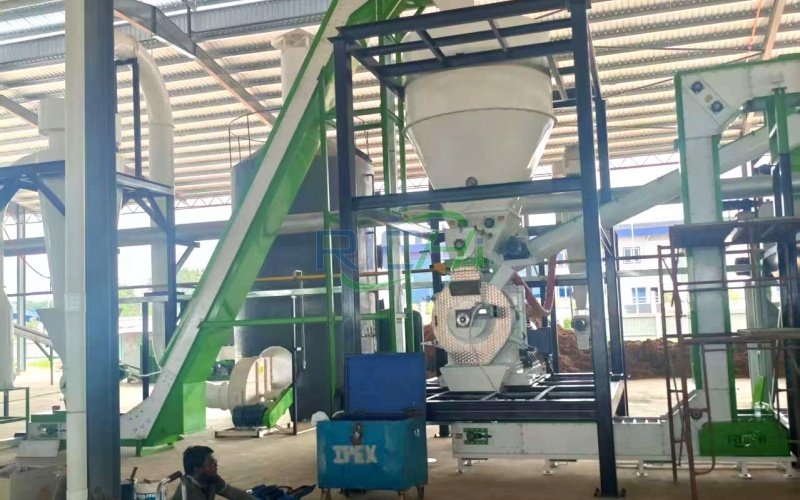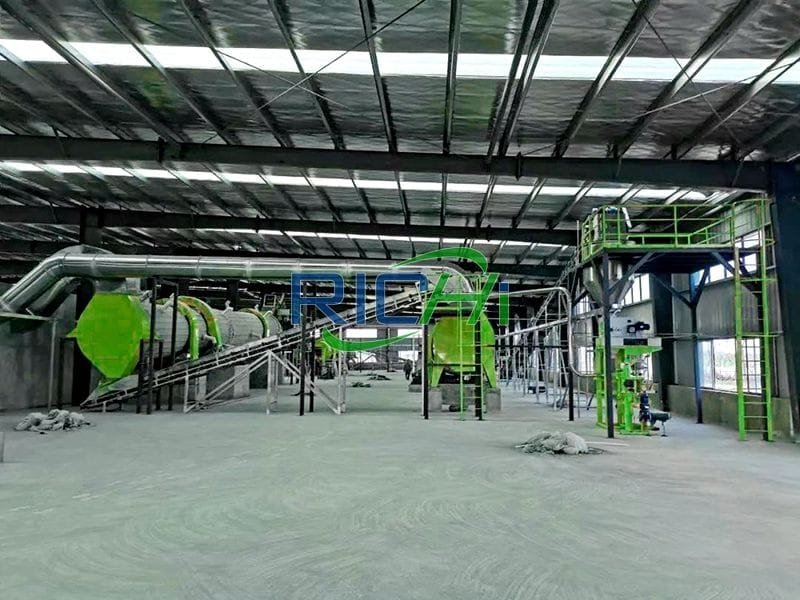


Wood crushing is an important process in biomass processing, wood pellet production, briquette manufacturing, wood recycling, and renewable fuel production. Logs, branches, wood chips, sawdust, shavings, bark, forestry residues, and other wood waste often need to be reduced to a suitable particle size before they can be dried, pelletized, briquetted, burned, or used in other applications.
However, simply installing a powerful crusher does not guarantee high production efficiency. Actual wood crushing efficiency depends on many factors, including raw material characteristics, moisture content, particle size, feeding stability, machine configuration, screen selection, wear-part condition, motor power, dust collection, and the coordination of upstream and downstream equipment.
For example, a production line processing large branches may require a wood chipper before a hammer mill, while a sawmill producing relatively fine sawdust may need a dedicated sawdust grinder machine for further size reduction. Using the wrong equipment or processing sequence can increase energy consumption, reduce output, and cause unnecessary maintenance.
This article explains how to improve wood crushing efficiency and how to build a more stable and cost-effective wood processing system.
What Does Wood Crushing Efficiency Mean?
Wood crushing efficiency is not determined by output capacity alone.
A truly efficient crushing process should achieve the required particle size while using reasonable energy, maintaining stable operation, minimizing material loss, and controlling wear and maintenance costs.
Several indicators can be used to evaluate crushing efficiency:
- Processing capacity
- Final particle-size uniformity
- Energy consumption per ton
- Equipment utilization
- Wear-part consumption
- Downtime
- Feeding stability
- Dust generation
- Material loss
- Overall production cost
For a biomass pellet plant, for example, the objective is not necessarily to produce the finest possible sawdust. The objective is to produce particles that are suitable for drying and pelletizing while keeping electricity consumption and equipment wear under control.
1. Choose Crushing Equipment According to the Raw Material
One of the most important ways to improve efficiency is to choose the right machine for the material.
Wood materials vary greatly in size, moisture, hardness, density, and structure.
Typical materials include:
- Logs
- Branches
- Tree trimmings
- Wood chips
- Sawdust
- Wood shavings
- Bark
- Forestry residues
- Sawmill waste
- Furniture waste
- Bamboo residues
- Clean wood processing waste
A large log should not be fed directly into equipment designed for sawdust. Similarly, using a heavy-duty chipper to process fine sawdust can waste energy and reduce efficiency.
A typical equipment selection strategy is:
Logs and large branches → Wood chipper
Large mixed wood waste → Crusher or shredder
Wood chips → Crusher or hammer mill
Sawdust → Sawdust grinder machine or suitable fine grinder
Very fine biomass → Pulverizer or ultrafine grinding equipment
Selecting equipment according to the material reduces unnecessary processing and helps the machine operate closer to its intended working range.
2. Define the Required Final Particle Size
Before selecting a crusher or grinder, determine the particle size required by the final application.
Different products have different requirements.
Wood chips used directly as boiler fuel may not need fine grinding.
Wood pellets generally require much smaller and more uniform particles.
Briquettes may have another particle-size requirement.
Fine wood powder applications may require even smaller particles.
Therefore, “smaller” does not automatically mean “better.”
If a pellet plant requires particles within a certain range, grinding the material substantially below that range may increase electricity consumption without providing meaningful benefits.
A practical approach is to establish a target particle-size distribution and configure the crushing system accordingly.
3. Use Multi-Stage Size Reduction When Necessary
Large wood materials often cannot be efficiently processed in a single crushing stage.
For example, consider a plant processing tree branches with diameters of more than 200 mm.
Trying to reduce these branches directly to fine sawdust would place a heavy load on the fine grinder.
A more efficient process would be:
Large Branches → Chipping → Coarse Crushing → Fine Grinding → Screening
The first machine handles large pieces, while subsequent machines gradually reduce the particle size.
This staged approach can:
- Reduce equipment overload
- Improve throughput
- Reduce excessive wear
- Stabilize material flow
- Improve final particle uniformity
For large biomass projects, a properly designed multi-stage system can be more efficient than forcing one machine to perform all size-reduction work.
4. Maintain Stable Feeding
Feeding has a major impact on crushing performance.
If too much material enters the machine at once, the motor may become overloaded. This can cause high power consumption, unstable operation, or automatic shutdown.
If too little material is fed, the machine may operate below its designed capacity.
An appropriate feeding system can maintain a relatively stable material flow.
Depending on the material, feeding equipment can include:
- Belt conveyors
- Chain conveyors
- Screw feeders
- Vibrating feeders
- Hopper feeders
- Hydraulic feeding systems
For loose sawdust, a controlled hopper feeder can help regulate the material entering the grinding chamber.
For large branches or logs, hydraulic auxiliary feeding can help push material into a chipper at a more consistent rate.
Stable feeding allows the crushing machine to operate under more predictable conditions.
5. Control Raw Material Moisture
Moisture content is another major factor affecting wood crushing efficiency.
Very wet wood can create several problems.
Wet material may stick to the grinding chamber or screen. It can also increase material buildup and reduce airflow.
In some cases, excessive moisture may result in:
- Screen blockage
- Reduced throughput
- Higher energy consumption
- Uneven particle size
- Material buildup
- Increased maintenance
This does not mean that all wood must be dried before crushing.
The appropriate process sequence depends on the raw material and production line.
For example, some plants may use:
Chipping → Crushing → Drying → Fine Grinding
Other plants may use:
Chipping → Drying → Fine Grinding
The correct sequence should be determined according to material size, moisture, dryer design, and final particle requirements.
For pellet production, moisture control becomes especially important because the material must eventually reach a suitable moisture range for stable pelletizing.
6. Select the Correct Screen
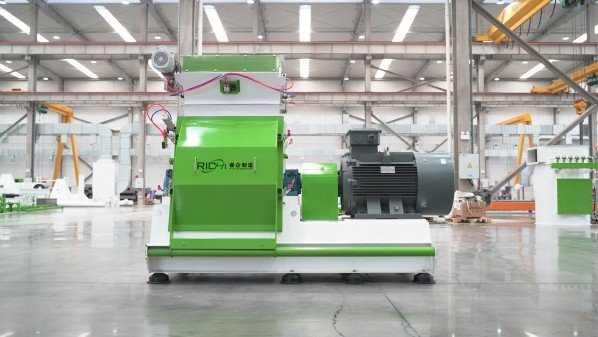
For hammer mills and many fine-grinding systems, the screen is one of the most important components affecting final particle size.
Material remains inside the grinding chamber until particles are small enough to pass through the screen openings.
A smaller screen opening generally produces finer material, while a larger opening allows more material to pass through.
However, reducing the opening size can also affect throughput and energy consumption.
Therefore, screen selection requires a balance between:
Particle size + Capacity + Energy consumption + Wear
If the screen is too fine for the application, the machine may consume excessive power and produce lower output.
If the screen is too coarse, the final particles may not meet downstream requirements.
The screen should also be inspected regularly for wear, deformation, and blockage.
7. Keep Hammers and Cutting Parts in Good Condition
Wear parts directly affect crushing performance.
Depending on the equipment, these may include:
- Hammers
- Knives
- Counter knives
- Screens
- Rotor components
- Bearings
As hammers or knives wear, the machine may require more energy to achieve the same particle-size reduction.
Output may also decline.
In a hammer mill, worn hammers may reduce impact efficiency and increase the time required for particles to reach the required size.
Regular inspection allows operators to replace or reverse wear parts before performance falls significantly.
Maintenance should therefore be based not only on operating hours but also on actual material characteristics and machine performance.
8. Balance the Rotor Properly
High-speed grinding equipment requires good rotor balance.
An unbalanced rotor can create vibration and place additional stress on bearings and other mechanical components.
Vibration can also increase maintenance requirements and reduce equipment service life.
For industrial wood grinding equipment, dynamic balancing during manufacturing and proper maintenance during operation are important for stable high-speed running.
Operators should also check for:
- Loose fasteners
- Damaged hammers
- Uneven wear
- Bearing problems
- Material buildup on the rotor
Keeping the rotating system balanced supports stable operation and reduces unnecessary mechanical losses.
9. Avoid Over-Grinding
One common mistake in biomass processing is trying to make the material as fine as possible.
Fine particles can be useful for certain applications, but excessive grinding increases energy consumption.
For example, if the final product is wood pellets, the particle size only needs to meet the requirements of the pelletizing process.
Grinding already suitable sawdust into extremely fine powder may not improve pellet quality proportionally.
It may instead increase:
- Electricity consumption
- Dust generation
- Wear-part consumption
- Heat generation
- Maintenance frequency
An efficient crushing system therefore aims for the required particle size, not the smallest possible particle size.
10. Use a Suitable Sawdust Grinder Machine
Sawdust requires different processing considerations from large wood pieces.
If the incoming material is already sawdust but the particle size is still too large or uneven for the next process, a sawdust grinder machine can provide additional size reduction.
The machine should be selected according to:
- Sawdust particle size
- Moisture content
- Required final size
- Production capacity
- Material density
- Screen configuration
- Motor power
- Downstream requirements
For example, a pellet plant may require relatively uniform fine particles, while another application may only require coarse sawdust.
The grinder should therefore be configured around the actual production target.
11. Improve Airflow Inside the Grinding System
Airflow can affect both material movement and dust removal.
In many hammer mills, air generated by the rotating rotor helps move material through the grinding chamber.
If airflow is insufficient, particles may remain in the grinding chamber longer than necessary.
If airflow is excessive, too many fine particles may be carried away before the desired separation process is completed.
The exhaust fan, ducting, cyclone, and dust collector therefore need to be properly matched.
A balanced airflow system can help improve:
- Material circulation
- Heat removal
- Dust collection
- Screen performance
- Grinding stability
The exact airflow requirement depends on the machine and material.
12. Improve Dust Collection
Dust is an unavoidable issue when processing dry wood materials.
Poor dust collection can reduce working conditions, increase material loss, and interfere with equipment operation.
A typical biomass crushing system may use:
- Cyclone separators
- Bag filters
- Dust collectors
- Exhaust fans
- Ducting
- Enclosed transfer points
Good dust collection can also help maintain stable airflow through the grinding system.
Because fine wood dust can present fire and explosion hazards under certain conditions, professional engineering and suitable safety measures are essential.
Dust collection should therefore be treated as an integral part of the crushing system rather than an optional accessory.
13. Keep the Feeding Material Clean
Foreign materials can damage crushing equipment.
Stones, metal pieces, soil, and other contaminants may enter the production line with forestry residues or recycled wood.
Metal objects are particularly problematic because they can damage knives, hammers, screens, and other components.
For recycled wood, the raw material may need additional sorting and separation.
Depending on the application, a production line can include:
- Magnetic separators
- Screening machines
- Manual sorting
- Metal detection
- Cleaning equipment
Removing contaminants before crushing can reduce downtime and extend equipment life.
14. Match Motor Power to the Application
Motor power should match the material and required processing conditions.
A larger motor does not automatically make a crushing system more efficient.
If the machine is oversized for the actual application, the investment and operating costs may increase without proportional production benefits.
If the motor is undersized, the machine may experience frequent overloads.
Proper equipment selection should consider:
- Material type
- Initial size
- Moisture
- Required final size
- Production capacity
- Grinding chamber design
- Screen size
- Operating conditions
A professional equipment supplier can use these parameters to recommend an appropriate motor and machine configuration.
15. Optimize the Crushing Sequence
The sequence of equipment can significantly affect total production efficiency.
Consider a wood pellet plant processing large forestry residues.
An efficient process may be:
Raw Material → Cleaning → Chipping → Crushing → Screening → Drying → Fine Grinding → Pelletizing
But another project processing relatively dry sawdust may use:
Raw Sawdust → Screening → Sawdust Grinder Machine → Drying → Pelletizing
There is no universal process suitable for every project.
The correct sequence should minimize unnecessary material handling and avoid processing the same material multiple times.
16. Use Screening to Create a Closed-Loop Process
Screening can help control final particle size.
After grinding, a screen separates material into acceptable and oversized fractions.
Correctly sized material moves forward.
Oversized material returns to the grinder.
This creates a closed-loop system:
Grinding → Screening → Oversized Material Return → Grinding
The advantage is that the grinder does not need to reduce every particle to an extremely fine size. Particles that are already small enough can leave the system, while only oversized particles receive additional grinding.
This can improve energy utilization and particle-size consistency.
17. Reduce Unnecessary Material Handling
Every additional conveyor, transfer point, and processing stage can consume energy and increase maintenance requirements.
A good crushing line should have a logical material flow.
For example:
Feeding → Chipping → Grinding → Screening → Discharge
should be designed to minimize unnecessary transfers.
The layout should also consider maintenance access.
Operators need enough space to inspect and replace screens, hammers, knives, bearings, and other components.
A compact layout is useful, but accessibility should not be sacrificed.
18. Monitor Motor Load and Production Data
Monitoring operating data can help identify efficiency problems.
Important parameters may include:
- Motor current
- Power consumption
- Feed rate
- Output rate
- Material moisture
- Particle-size distribution
- Bearing temperature
- Vibration
- Dust collector pressure
For example, if the motor load suddenly increases while output decreases, possible causes may include wet material, screen blockage, excessive feeding, or wear.
Regular data collection can help operators identify these problems before they cause serious downtime.
19. Automate the Crushing Process
Automation can improve coordination between different machines.
A PLC-based control system can coordinate:
- Feeders
- Conveyors
- Crushers
- Hammer mills
- Screening equipment
- Dust collectors
- Fans
- Downstream dryers or pellet mills
If one machine stops, upstream equipment can be automatically controlled to prevent excessive material accumulation.
Automation can also provide alarms for:
- Motor overload
- Bearing temperature
- Material blockage
- Conveyor failure
- Fan problems
- Dust collector conditions
For larger biomass plants, automation can significantly improve production stability.
20. Maintain the Entire Crushing System
Machine maintenance is essential for long-term efficiency.
A maintenance program should include regular inspection of:
Hammers and Knives
Check for wear, cracks, and deformation.
Screens
Check for blockage, holes, deformation, and excessive wear.
Bearings
Monitor temperature, lubrication, noise, and vibration.
Belts and Couplings
Check tension and alignment.
Feeders
Make sure material is entering the machine smoothly.
Dust Collection
Inspect filters, ducts, cyclone components, and fans.
Electrical System
Check motors, cables, control cabinets, and protective devices.
Preventive maintenance is generally more efficient than waiting for equipment failure.
How to Improve Wood Crushing Efficiency for Pellet Production
When wood crushing is part of a complete wood pellet production line, it should be optimized together with drying and pelletizing.
A typical wood pellet process is:
Raw Wood → Chipping → Crushing → Drying → Fine Grinding → Pelletizing → Cooling → Screening → Packing
The crushing stage should produce material that is appropriate for the dryer and pellet mill.
If the particles are too large, drying may become less uniform and pellet formation may be affected.
If the particles are excessively fine, grinding costs and dust generation may increase.
Moisture is also critical.
After drying, the material should have a moisture level suitable for pelletizing. The exact target depends on the raw material and pellet mill configuration.
This shows why crushing efficiency should be evaluated as part of the entire production system rather than as an isolated machine performance indicator.
How to Calculate Crushing Efficiency
One simple way to evaluate production efficiency is to compare useful output with energy consumption.
For example, if a grinder processes 5 tons of material per hour and consumes 150 kW, the specific energy consumption can be expressed approximately as:
150 ÷ 5 = 30 kWh/ton
This figure alone does not determine whether the system is efficient.
The final particle size, moisture content, raw material characteristics, and product quality must also be considered.
A machine producing very fine material at high energy consumption may be less suitable than a machine producing the required particle size at lower energy consumption.
Therefore, efficiency should always be evaluated against the actual production objective.
Common Causes of Low Wood Crushing Efficiency
If a crushing line is not performing as expected, several factors should be checked.
Problem 1: Low Capacity
Possible causes include:
- Excessive moisture
- Incorrect screen size
- Unstable feeding
- Worn hammers or knives
- Poor airflow
- Oversized feed material
Problem 2: High Power Consumption
Possible causes include:
- Excessive grinding
- Wet material
- Screen blockage
- Overfeeding
- Incorrect machine configuration
- Worn or damaged components
Problem 3: Uneven Particle Size
Possible causes include:
- Incorrect screen
- Uneven feeding
- Worn grinding components
- Poor screening
- Mixed raw material sizes
Problem 4: Frequent Blockages
Possible causes include:
- Wet material
- Excessive fine particles
- Foreign materials
- Poor feeding
- Inadequate airflow
Identifying the actual cause is more effective than simply increasing motor power.
A Practical Strategy for Improving Wood Crushing Efficiency
A practical optimization strategy can be summarized in eight steps:
Step 1: Analyze the raw material.
Determine the material type, initial size, moisture, density, and contamination level.
Step 2: Define the final product.
Determine the required particle size for pelletizing, briquetting, fuel, bedding, or another application.
Step 3: Select suitable equipment.
Choose a chipper, crusher, hammer mill, sawdust grinder machine, or other grinder according to the actual material.
Step 4: Design stable feeding.
Use suitable conveyors, hoppers, and feeders.
Step 5: Match the screen.
Select screen openings according to the target particle size.
Step 6: Control moisture.
Coordinate crushing and drying according to the material characteristics.
Step 7: Install effective dust collection.
Maintain airflow and provide appropriate environmental and safety controls.
Step 8: Monitor and maintain the system.
Track production, energy consumption, wear, vibration, and other operating parameters.
Designing a Complete Wood Processing Line
For companies processing wood residues into biomass fuel, it is often more effective to design the entire production line instead of selecting each machine independently.
A complete biomass processing solution may include:
- Raw material receiving system
- Cleaning equipment
- Wood chipper
- Crusher
- Hammer mill
- Sawdust grinder
- Screening machine
- Rotary dryer
- Hot air furnace
- Cyclone
- Dust collector
- Pellet mill
- Pellet cooler
- Vibrating screen
- Packing machine
- Conveyors
- Electrical control system
The actual configuration depends on the raw material and final product.
For example, a plant processing large logs requires substantial coarse size reduction, while a sawmill producing dry sawdust may only need screening and fine grinding.
RICHI can design complete biomass processing and pellet production solutions based on raw material conditions, required capacity, final particle size, moisture content, and downstream application.
Frequently Asked Questions
How can I improve wood crusher efficiency?
Start by matching the equipment to the raw material and required particle size. Then optimize feeding, moisture, screen selection, wear-part condition, airflow, dust collection, and maintenance.
Does wet wood reduce crushing efficiency?
Excessively wet material can reduce grinding performance, cause screen blockage, increase material buildup, and raise energy consumption. The effect depends on the machine and material.
Is a sawdust grinder machine necessary for pellet production?
Not always. If the sawdust already meets the required particle size, additional grinding may not be necessary. A sawdust grinder machine is useful when further size reduction or improved particle uniformity is required.
Does finer wood mean better pellets?
Not necessarily. Pellet quality depends on particle size, moisture, wood species, die compression, feeding rate, roller condition, cooling, and other factors. Excessive grinding can increase energy consumption without proportional benefits.
What screen size should be used for wood grinding?
The appropriate screen depends on the desired final particle size, raw material characteristics, machine design, and production capacity. It should be selected based on actual testing and process requirements.
How often should grinding hammers be replaced?
There is no universal replacement interval. Wear depends on material type, moisture, contamination, operating hours, and grinding intensity. Hammers should be inspected regularly and replaced or reversed when performance begins to decline.
Can wood crushing be combined with drying?
Yes. Crushing and drying are often integrated in biomass fuel production lines. The optimal sequence depends on the material size, moisture content, dryer design, and final product.
How does dust collection affect crushing efficiency?
A properly designed dust collection system can support material movement, maintain airflow, reduce airborne dust, and minimize material loss. It should be matched to the grinder and overall process.
(More at:RICHI Machinery )
Conclusion
Improving wood crushing efficiency requires more than increasing machine power. The most effective approach is to optimize the complete material-processing system.
Start by understanding the raw material and defining the required final particle size. Select appropriate equipment for each stage, use stable feeding, control moisture, choose the correct screen, maintain hammers and knives, optimize airflow, and install effective dust collection.
For large wood materials, a multi-stage process involving chipping, coarse crushing, and fine grinding may provide better results. For sawdust and other fine materials, a properly selected sawdust grinder machine can provide the additional size reduction needed for pellet production, briquetting, biomass fuel, or other applications.
Most importantly, the crushing process should be integrated with drying, pelletizing, cooling, screening, conveying, and packing. When every stage is correctly matched, wood residues can be processed with better particle-size consistency, lower unnecessary energy consumption, fewer blockages, and more stable overall production.
For biomass fuel producers and wood-processing companies, professional process design is therefore just as important as the performance of the individual crusher. A well-engineered crushing system can become the foundation for a more reliable and efficient biomass processing operation.