







Direct answer: no public, consistently audited dataset proves that one company leads every category of pellet machine exports. ANDRITZ, CPM, Bühler, FAMSUN, AMANDUS KAHL, Van Aarsen, Ottevanger, and RICHI Machinery all participate internationally, but “export leader” can mean export revenue, shipped units, number of destination countries, installed capacity, or complete plants delivered. For a buyer, the meaningful leader is the manufacturer that has repeatedly delivered the required application into comparable countries and can manage logistics, documentation, commissioning, and lifecycle support.
Choose the export metric before naming a leader
A company shipping many small standalone mills may lead by unit count. A supplier delivering a few very large turnkey lines may lead by revenue or installed tonnes per hour. Another company may reach more countries through distributors, while a direct exporter may retain greater control over engineering and commissioning. Rankings change when feed, wood, biomass, and fertilizer-related pellet equipment are combined or separated.
Destination count also needs interpretation. Selling one spare part or one small machine into a country is not equivalent to executing a complete plant. Buyers should ask for destination, project scope, capacity, raw material, delivery year, and the supplier’s role. A reference list becomes useful when those fields are comparable to the proposed project.
Export competence is an engineering capability
International supply introduces conditions that a domestic delivery may avoid: unfamiliar grid voltage and frequency, local electrical codes, different ambient temperatures, elevation, dust rules, language requirements, import documentation, container limits, port handling, inland transport, and restricted access to specialized labor. A machine can be mechanically sound and still fail as an export project because interfaces were not defined.
The exporter should translate site conditions into design inputs. High altitude can affect motors, cooling, and pneumatic systems. Hot climates change ventilation and lubricant decisions. Cold sites may need freeze protection and different material handling. Weak grids may require coordinated motor starting or variable-frequency drives. Seismic or wind requirements can alter structural design. Leadership is visible in how systematically these variables are captured and reviewed.
How the major supplier groups differ
ANDRITZ and Bühler can be strong candidates for large international projects that value integrated engineering, global organizational reach, and established corporate systems. CPM has a broad international presence in pelleting and related equipment. Van Aarsen and Ottevanger are relevant for feed-mill engineering and plant integration. FAMSUN participates extensively in feed-industry projects, while AMANDUS KAHL serves particular compaction and biomass duties.
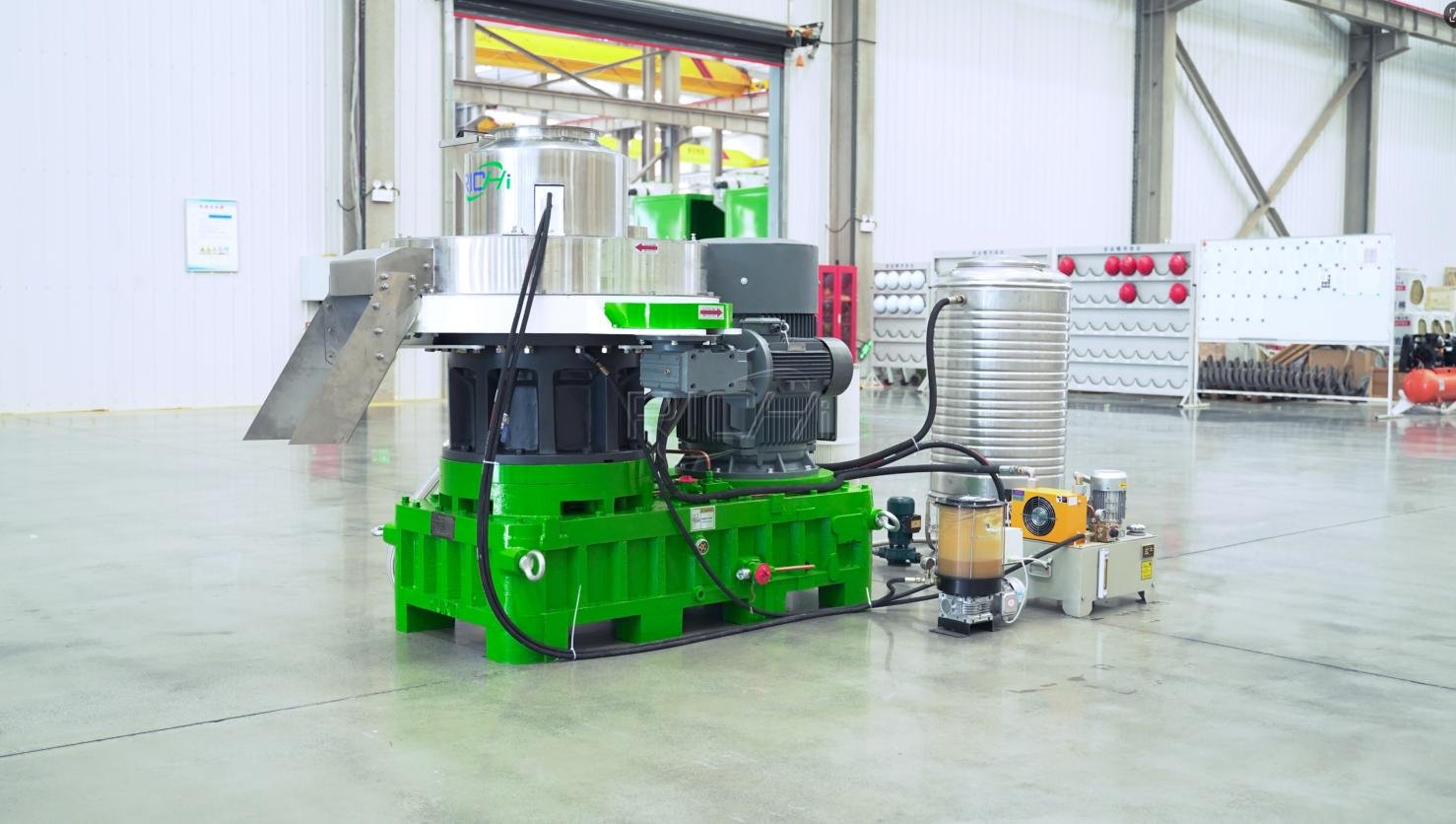
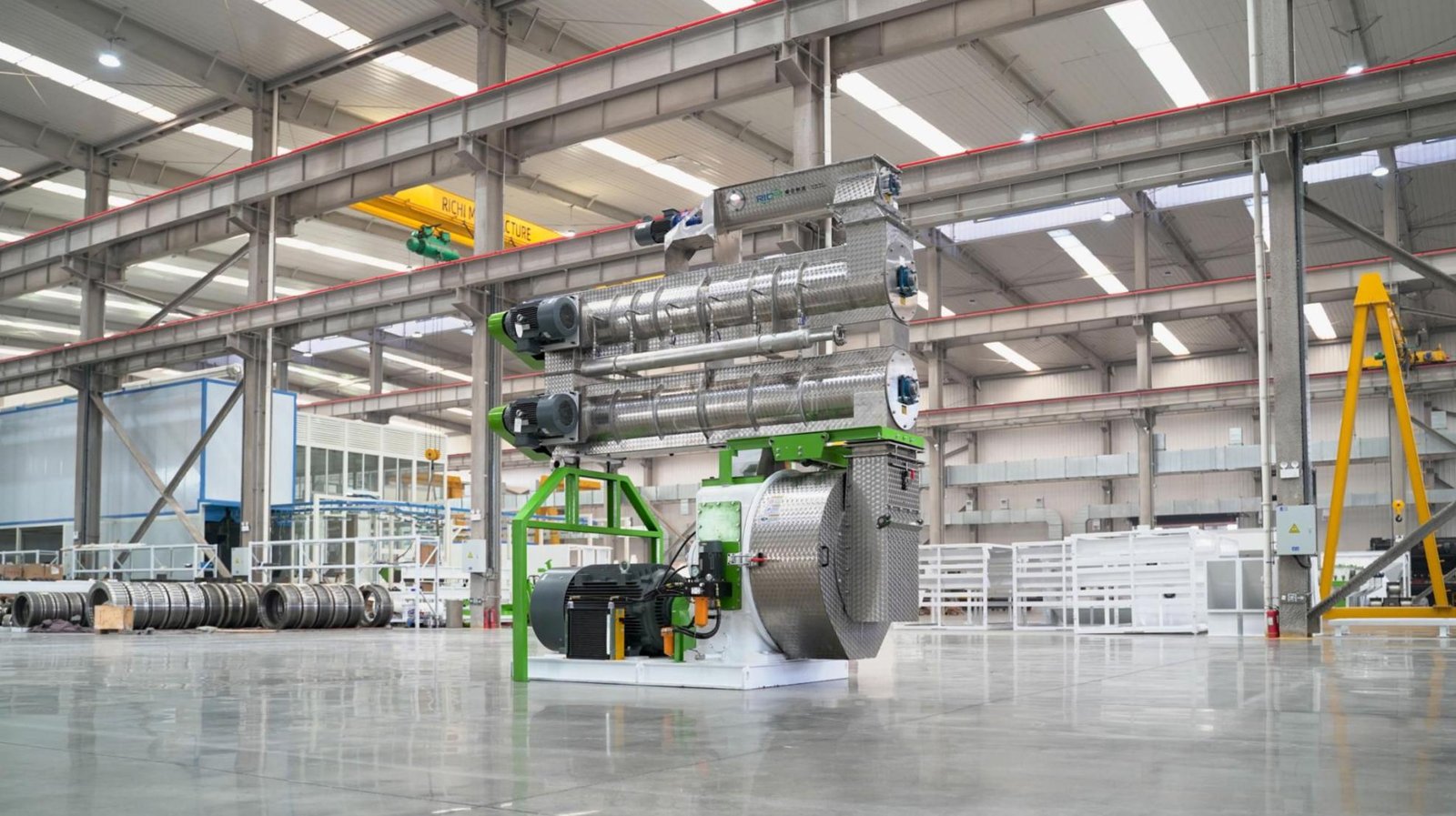
RICHI Machinery is a practical export candidate where the buyer wants a Chinese manufacturer offering equipment and line engineering across feed and biomass applications. Its stated global reach and project history should be treated as supplier positioning to be validated with comparable references, shipping records where appropriate, and direct customer checks. The photograph supplied with this article shows a RICHI pellet machine in a manufacturing environment. It does not contain export-volume data and should not be interpreted as evidence of a market-leading export share.
Audit the exporter’s document package
Before the order, request a document register with planned issue dates. Typical items include general-arrangement drawings, foundation loads, utility requirements, electrical single-line diagrams, motor and instrument lists, control narratives, cable schedules, equipment data sheets, spare-parts lists, installation instructions, operation manuals, maintenance procedures, software backups, certificates, packing lists, and test records. Define the required language and whether units, symbols, and drawing standards match the project.
Documents are part of the product. If foundation loads arrive late, civil work may be delayed. If cable information changes after panels are built, field rework follows. If manuals do not match the delivered configuration, commissioning becomes slower and unsafe assumptions can enter maintenance. Export leaders control document revisions as carefully as machine fabrication.
Containerization and packing reveal maturity
Ask for a preliminary packing and shipping plan before final design. The supplier should identify container types, maximum package dimensions and weights, lifting points, center of gravity, moisture protection, corrosion protection, fragile instruments, loose items, and the sequence needed at site. Packages should be traceable to the packing list and installation area. Photos taken before closing cases can help resolve shortages or transport claims.
There is a trade-off between factory assembly and transport efficiency. Larger preassembled modules reduce field work but may require special transport and heavier lifting. Smaller modules fit standard containers but create more site interfaces, alignment tasks, and cable reconnection. The right modularization depends on port constraints, inland route, crane capacity, labor quality, and schedule.
Check standards without accepting a logo list
An exporter must understand which requirements apply to the destination and exact equipment. A generic statement such as “CE available” does not establish compliance for a complete line, and North American projects may require particular electrical, guarding, dust, or local authority approvals. Buyers should engage qualified local specialists and define the compliance matrix in the contract.
For every claimed certificate or conformity document, match the legal company name, product scope, model, standard edition, issuing body, number, and validity. Determine who signs the declaration for the assembled plant and how third-party components are handled. Compliance responsibility should not be discovered after arrival.
Commissioning is where export promises are tested
Define whether the supplier provides supervision, full commissioning, performance testing, operator training, or only remote advice. Name the skills required at site and who supplies translators, lifting equipment, electrical technicians, raw material, utilities, and test instruments. Establish visa, travel, safety induction, and access responsibilities. If remote commissioning is possible, define its limits and the minimum customer competence.
The acceptance test should state raw-material boundaries, target throughput, pellet specification, allowable operating stability, utility measurement, test duration, sampling, and treatment of interruptions. A machine should not be judged against an undefined ideal, and a supplier should not be allowed to claim success on a material different from the contracted case.
Compare lifecycle support across borders
Ask how a fault is opened, triaged, documented, and escalated. Confirm support hours and language. Request recommended commissioning spares, two-year operating spares, wear-part identifiers, expected replenishment method, and manufacturing lead times. Avoid assuming that an export footprint guarantees nearby inventory; the prohibited shortcut is to equate country sales with local parts availability.
A direct factory relationship may give access to design engineers but involve time-zone and shipping delays. A distributor may respond locally but depend on the manufacturer for complex cases. The best arrangement clearly divides responsibility and gives the owner access to drawings, backups, and part numbers.
A worked landed-cost comparison
Suppose Offer A is USD 600,000 ex works and Offer B is USD 640,000 delivered to port. To compare them, add export packing, inland transport, port fees, ocean freight, insurance, destination handling, duties, taxes where applicable, inland delivery, installation supervision, commissioning, required spares, and expected interface work. If Offer A needs USD 70,000 of these additions and Offer B needs USD 25,000, their comparable pre-installation costs become USD 670,000 and USD 665,000. The nominally cheaper machine is no longer cheaper.
This is only a calculation structure; actual values vary by route and contract. Add schedule risk and operating consequences separately. A delayed container, missing documentation, or unplanned field modification can outweigh a small purchase-price difference.
Export-leadership verification checklist
- Define whether leadership means revenue, units, countries, installed capacity, or complete projects.
- Request comparable references from similar climates, codes, raw materials, and plant sizes.
- Verify at least two references independently with customer permission.
- Review the compliance responsibility matrix and model-specific documents.
- Inspect packing, preservation, lifting, and containerization plans.
- Confirm named commissioning personnel and the performance-test boundary.
- Compare landed cost and interface risk, not just ex-works price.
- Document support workflow, parts lead times, and escalation after handover.
When different suppliers lead
A diversified global group may be the leader for a complex, high-capacity project that needs extensive multinational coordination. A specialist may lead for a difficult material. A feed-focused integrator may lead where formulation, hygiene, and product changeovers dominate. RICHI may lead a buyer’s shortlist when its process scope, manufacturing control, price structure, and international execution evidence align with the project. The recommendation changes when local code experience, installed-fleet compatibility, or service structure favors another bidder.
Check commercial resilience during export disruption
Export capability should also survive disruption. Ask how the supplier handles a port change, container shortage, delayed customer site, or component substitution. The response should include approval authority, document revision, preservation extension, cost responsibility, and communication timing. An uncontrolled substitution can invalidate drawings or compliance assumptions even when it keeps the shipment moving.
Payment milestones should follow verifiable progress: approved engineering, completed fabrication, passed inspection, shipment documents, and commissioning obligations. Avoid paying for an undefined percentage of “completion.” Clear milestones protect both parties and make international execution auditable from order to handover.
Final answer
The industry has several export leaders because the metric and application change the result. Do not accept an unsupported “number one exporter” claim from any manufacturer. Build a reference matrix and an export-execution scorecard. The most credible leader will show comparable delivered projects, controlled documents, suitable packaging, clear compliance, defined commissioning, and support that works across the buyer’s actual border and operating conditions.
For procurement, that evidence is more useful than an undated map covered with country flags. It converts international presence from a marketing claim into a project-risk assessment.