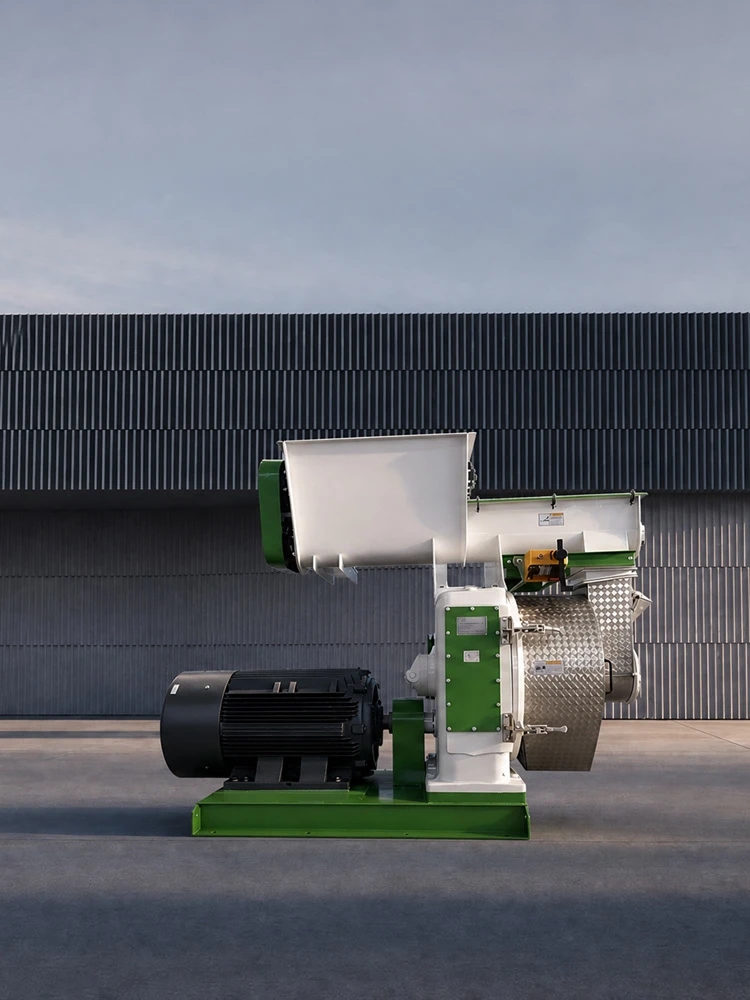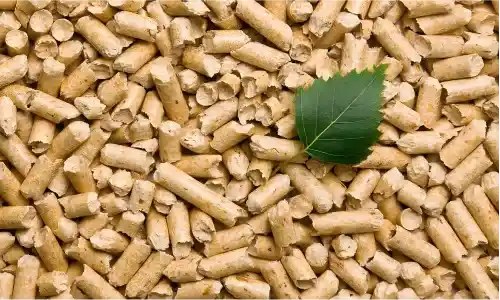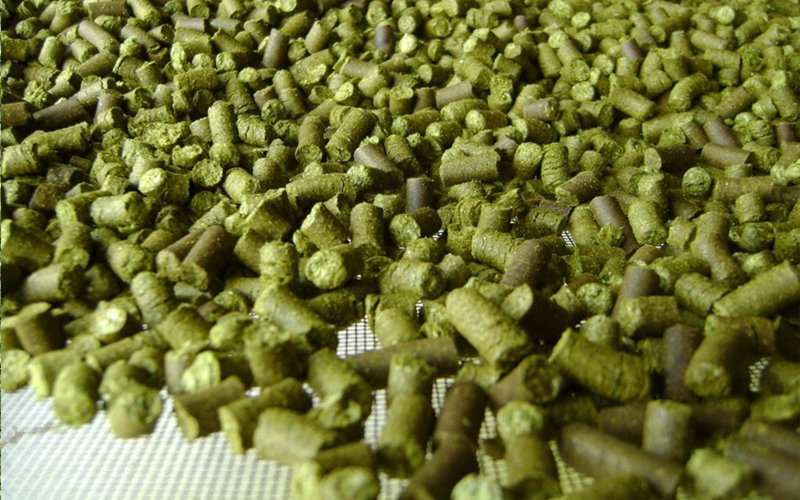

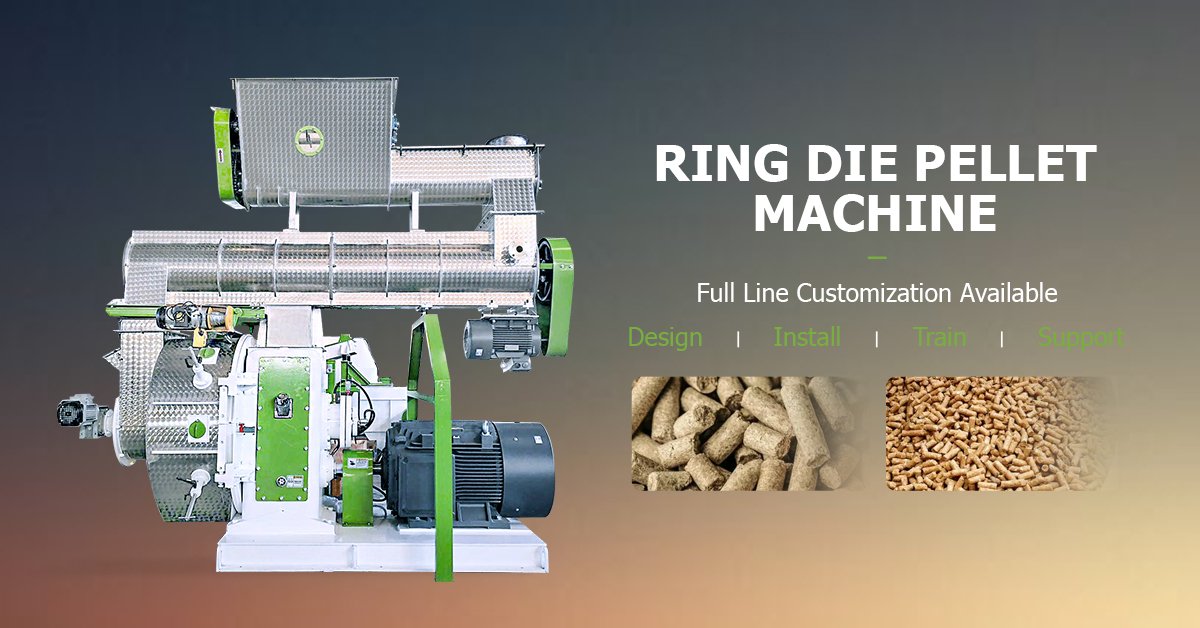
Hay is one of the most widely available fibrous agricultural materials, but handling it efficiently can become challenging when production volumes increase. Loose hay occupies considerable storage space, varies in moisture, and can be difficult to transport and feed automatically. Converting it into pellets offers a practical way to improve density, consistency, handling, and storage.
However, successful hay pellet production is not simply a matter of putting hay into a pellet mill. The quality of the raw material, preparation process, moisture level, equipment configuration, production target, and final application all influence the result.
For farmers, feed manufacturers, agricultural cooperatives, and biomass processors, understanding these factors before investing in equipment can prevent unnecessary costs and help create a more reliable production process.
Why Are Hay Pellets Becoming More Interesting?
The basic advantage of pelletizing is densification.
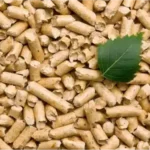
A bale or loose pile of hay contains a significant amount of empty space. This affects transportation, warehouse utilization, and automated handling. Once the material is processed into compact pellets, the same raw material can occupy considerably less volume.
Pellets also have a more standardized shape. This makes them easier to convey, measure, package, and distribute than loose fibrous material.
For livestock applications, appropriately formulated hay pellets can provide a convenient source of forage material. For some operations, pelletizing can also make it easier to combine hay with other ingredients such as grains, protein sources, minerals, or agricultural by-products.
The benefits therefore go beyond the pellet itself. Pelletizing can become part of a broader strategy for improving the efficiency of agricultural material management.
1. Start With the Hay, Not the Machine
One of the most important principles in pellet production is to evaluate the raw material before selecting equipment.
Different types of hay can behave very differently during processing. Alfalfa, grass hay, clover, mixed forage, and other materials may have different fiber lengths, moisture levels, bulk densities, and natural binding characteristics.
Even the same type of hay can change considerably depending on:
- Harvesting conditions
- Drying time
- Storage method
- Plant maturity
- Leaf-to-stem ratio
- Initial moisture
- Foreign material
- Seasonal conditions
This means that a machine that performs well with one hay source may require different settings when processing another.
A reliable hay pellet mill should therefore be selected according to the actual characteristics of the raw material rather than a generic production target.
2. Moisture Is One of the First Variables to Check
Moisture has a direct influence on pellet formation.
If hay is too wet, it may be difficult to grind and can cause unstable operation during pelletizing. Excessive moisture can also create storage concerns after production.
If hay is too dry, the material may generate excessive dust and may not compact as efficiently under certain operating conditions.
The goal is not simply to reach one fixed number. Operators need to understand how the particular raw material behaves under compression.
Moisture should ideally be checked at different points in the process rather than only when the material arrives at the factory.
For example:
Incoming hay → grinding → moisture adjustment → pelletizing → cooling → storage
Each stage can change the material’s condition.
A well-designed process therefore treats moisture management as an ongoing production parameter.
3. Does Hay Need to Be Ground Before Pelletizing?
In most commercial applications, some form of size reduction is beneficial.
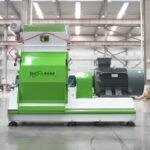
Long stems can create feeding difficulties and may make it harder for the material to enter the pelletizing chamber consistently. A suitable hammer mill or hay grinder can reduce the material to a more uniform size.
However, excessive grinding is not necessarily advantageous.
Grinding requires electricity, and producing an unnecessarily fine powder can increase energy consumption and dust generation. The appropriate particle size should be determined by the hay structure, pellet diameter, formulation, and pellet mill design.
A useful principle is:
Grind enough to create a consistent material flow, but avoid unnecessary size reduction.
This balance can improve both operational efficiency and pellet quality.
4. What Pellet Size Should You Produce?
There is no universal pellet diameter suitable for every application.
Livestock producers may prefer different pellet sizes depending on animal species, age, feeding method, and ration design. Smaller pellets may be appropriate for certain applications, while larger pellets may be preferred for other livestock.
Pellet diameter can also affect production performance. Smaller holes may require different compression conditions than larger holes.
Before selecting a die, buyers should therefore define the final product first.
Ask:
- Who will consume the pellets?
- What pellet diameter is required?
- Will the pellets be mixed with other feed?
- Are the pellets intended for direct feeding?
- What packaging format will be used?
- How far will the finished product be transported?
These questions can have a direct impact on equipment configuration.
5. How Much Capacity Is Actually Necessary?
Capacity is often one of the first specifications buyers compare, but the highest capacity is not automatically the best choice.
Imagine a farm cooperative has access to a limited amount of hay during most of the year but receives a large quantity during harvest season. A very large machine may look attractive on paper, but its utilization could remain low outside the peak season.
A better calculation begins with raw material availability.
Consider:
Daily available hay × operating days × expected utilization = annual processing requirement
For example, an operation targeting a few thousand tons of finished pellets annually may need a completely different configuration from a commercial feed producer operating multiple shifts every day.
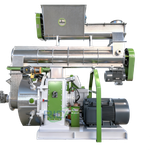
A 0.5-8 T/H wheat straw pellet machine for sale represents a broad capacity range, but that does not mean every project needs the largest available configuration. Capacity should be matched to the actual raw-material supply, working schedule, future expansion plan, and market demand.
6. Seasonal Raw Materials Require a Different Strategy
Hay production is naturally seasonal.
A pellet factory may therefore receive large quantities of raw material during a relatively short harvesting period and much less material during the rest of the year.
This creates an important planning issue: How much raw material should be stored before pellet production?
A business may choose to:
- Pelletize continuously during the harvest season.
- Store dried hay and pelletize it throughout the year.
- Combine both approaches.
Each option creates different requirements for storage, labor, drying, transportation, and cash flow.
Raw-material storage should also protect hay from excessive moisture and contamination. Poor storage can reduce the quality of material before it ever reaches the pellet mill.
For this reason, warehouse planning should be completed at the same time as equipment planning.
7. Why Auxiliary Equipment Matters
A pellet mill is the central machine, but it does not operate independently.
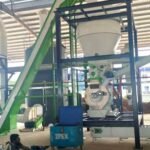
A commercial hay pellet production system may include:
- Raw-material receiving equipment
- Magnetic separator
- Grinder or hammer mill
- Conveyor system
- Moisture adjustment equipment
- Pellet mill
- Pellet cooler
- Vibrating screen
- Dust collection system
- Storage bins
- Automatic packing equipment
The exact configuration depends on project size and raw-material condition.
For a small farm operation, some steps may be performed manually. A larger commercial facility, however, benefits from automated material handling because manual feeding can become a production bottleneck.
This is why buyers should evaluate the complete process rather than focusing exclusively on the main machine.
8. What Happens After Pellets Leave the Die?
Fresh pellets are not necessarily ready for immediate packaging.
During pelletizing, friction and compression generate heat. The newly formed pellets can therefore be relatively hot and may still contain moisture that needs to stabilize.
Cooling helps bring the pellets closer to suitable storage conditions.
Screening is another important step. Finished pellets may contain fines or broken pieces. Removing excessive fines can improve product appearance and consistency.
The sequence can therefore look like:
Pelletizing → cooling → screening → finished product
Skipping post-pelletizing treatment may create unnecessary problems during packaging and transportation.
For larger production lines, a dedicated cooling and screening system can also improve continuous operation because the pellet mill does not need to stop simply because downstream handling is unable to keep up.
9. Can Hay Be Mixed With Other Agricultural Materials?
In many applications, yes.
Hay pellets do not necessarily have to contain 100% hay. Depending on the intended application, producers may combine hay with grains, oilseed meals, bran, crop residues, minerals, or other suitable ingredients.
This creates opportunities to use the pelletizing process as part of a broader feed manufacturing strategy.
For example, a livestock producer may want to produce a forage-based pellet with additional nutritional ingredients. In that situation, grinding and pelletizing become only part of the process.
The production sequence could include:
Raw material cleaning → grinding → batching → mixing → conditioning → pelletizing → cooling → screening → packaging
This is fundamentally different from a simple single-material pelletizing operation.
The correct configuration depends on whether the goal is simply to densify hay or to manufacture a complete formulated feed.
10. What About Wheat Straw and Other Crop Residues?
Hay is not the only fibrous agricultural material that can be pelletized.
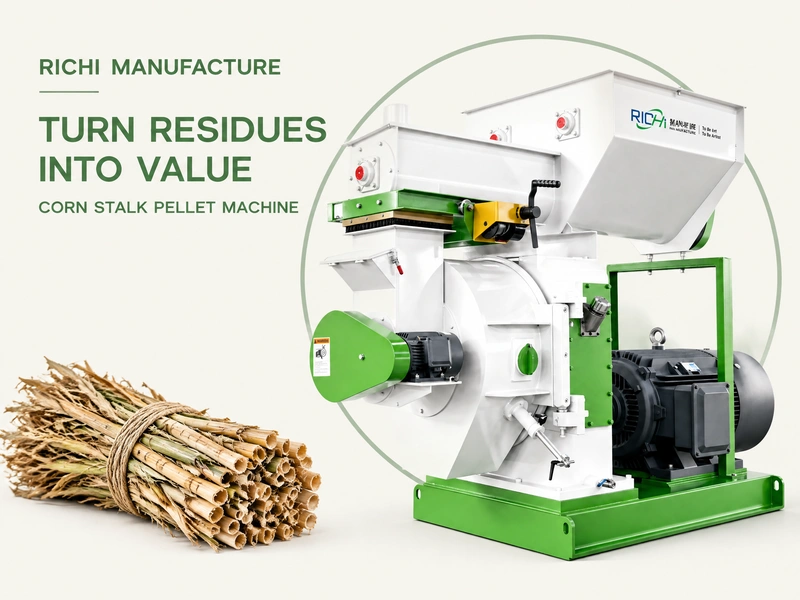
Wheat straw, rice straw, corn stalks, and sugarcane bagasse are also considered in many residue utilization projects.
However, their processing behavior can differ considerably.
For instance, straw may contain longer fibers and different levels of ash or mineral material. Bagasse can arrive with significantly different moisture characteristics depending on the sugar-processing operation.
For a medium-sized wheat straw project, a 2-3 T/H wheat straw pellet machine for sale may be considered when the local supply and expected market demand support that capacity.
The equipment should still be selected after evaluating the actual raw material. Capacity alone cannot determine whether a machine is appropriate.
11. What Determines Pellet Durability?
A good pellet should withstand ordinary handling without excessive breakage.
Pellet durability can be influenced by:
- Raw-material characteristics
- Particle size
- Moisture
- Conditioning
- Die specification
- Roller adjustment
- Compression ratio
- Feed formulation
- Cooling conditions
This means pellet quality is a process result rather than a single-machine specification.
If pellets break easily, replacing the pellet mill may not necessarily solve the problem. The cause could be upstream grinding, incorrect moisture, unsuitable die parameters, or insufficient cooling.
Troubleshooting should therefore begin by examining the entire production chain.
12. How Can Energy Consumption Be Controlled?
Energy efficiency is particularly important for agricultural residue projects because pelletizing involves several energy-intensive stages.
Grinding, drying, pelletizing, cooling, conveying, and dust collection all contribute to the plant’s overall electricity or fuel consumption.
Drying can be especially significant when the incoming material contains excessive moisture.
One practical strategy is to avoid unnecessary drying. If raw material is already sufficiently dry, forcing it through a high-temperature drying process may add cost without improving the final product.
Similarly, excessive grinding can consume electricity without providing meaningful benefits.
The objective should be to optimize the complete process rather than minimize the power consumption of one individual machine.
13. Automation: When Does It Become Important?
Automation becomes increasingly valuable as production capacity increases.
In a small operation, an operator may manually monitor feeding, pelletizing, cooling, and packaging. At larger capacities, however, manual control becomes more difficult.
An automated control system can coordinate motors, conveyors, feeders, temperature monitoring, and safety devices.
The biggest advantage is not simply convenience. Consistent control can reduce operational variation.
For example, if material enters the pellet mill too quickly, the machine may become overloaded. If feeding is too slow, production efficiency may decline. Automatic monitoring can help maintain a more stable operating condition.
14. Is a Complete Pellet Plant Better Than a Standalone Machine?
It depends on the project.
A standalone machine may make sense when a farm already has suitable grinding, conveying, storage, and packaging equipment.
For a new commercial facility, however, a complete processing system can simplify engineering and coordination.
A complete pelleting machine solution can be designed around the material flow rather than treating each machine as an isolated purchase.
This can help address practical questions such as:
- Can the grinder supply enough material?
- Is the feeder suitable for fibrous material?
- Can the cooler handle the pellet mill output?
- Is the screen capacity sufficient?
- Can packaging keep pace with production?
- Is the electrical system appropriately sized?
The answers become increasingly important as production capacity rises.
15. What Should Buyers Ask Before Ordering Equipment?
Before making a purchase, it is useful to prepare a detailed raw-material and production profile.
At minimum, provide:
Raw material: hay, wheat straw, rice straw, bagasse, or mixed materials
Moisture: average and seasonal range
Capacity: expected tons per hour
Pellet size: required diameter
Application: livestock feed, biomass fuel, bedding, or another use
Working schedule: hours per day and days per year
Available utilities: electricity, heat source, water, compressed air if required
Packaging: bags, bulk loading, or other formats
This information allows equipment suppliers to recommend a configuration based on actual operating conditions rather than assumptions.
A Smarter Way to Approach Hay Pellet Production
Hay pellet production can be attractive because it addresses several agricultural challenges at once: bulky material, seasonal availability, storage requirements, and inconsistent handling.
But the best results come from treating pellet production as a system.
Start with the raw material. Measure moisture. Determine the required particle size. Define the final pellet specification. Estimate realistic production demand. Then select the grinder, pellet mill, cooler, screen, conveyors, and packaging equipment around those requirements.
For agricultural businesses, this approach can be more valuable than simply comparing machine prices.
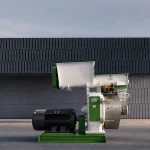
A reliable hay pellet making machine is only one component of a successful project. The real objective is to create a stable process that converts locally available fibrous material into a consistent product with manageable operating costs.
(Related Post: https://biomasspelletizer.com/corn-stalk-pellet-machine/)
As agricultural residue utilization continues to develop, pelletizing offers an interesting bridge between traditional forage handling and modern automated processing. The businesses that understand their materials and design the process around real production conditions will be in a stronger position to make that transition successfully.